
Built to see what others miss.
Low-observable autonomous aircraft, the onboard autonomy that runs the mission, and the cockpit one operator flies it from. Built for defense, public safety, and everyone the incumbents overlook.
When it matters most, the aircraft that could see it is on the ground.
The first ten minutes of a wildfire, a search, or a perimeter breach decide how the rest goes. The helicopter is tasked elsewhere. The crew is an hour out. The drone that could look is too expensive to risk. We close that gap with a quiet aircraft that flies itself, keeps working when the link drops, and costs a few thousand dollars to replace.
MarketsandMarkets, Research and Markets, U.S. DoD and DIU. Directional context, not a forecast of our share.
We build the brain, then give it the cheapest wings that work.
The brain and the cockpit are the product, carried by an aircraft built to be lost
Autonomy that finds what you asked for and keeps working when the link drops.
Grif is the brain of the aircraft: perception, memory, and decision making running on the aircraft's own computer, not on the ground. It speaks the open MAVLink protocol to the flight controller, so it flies our aircraft or yours.
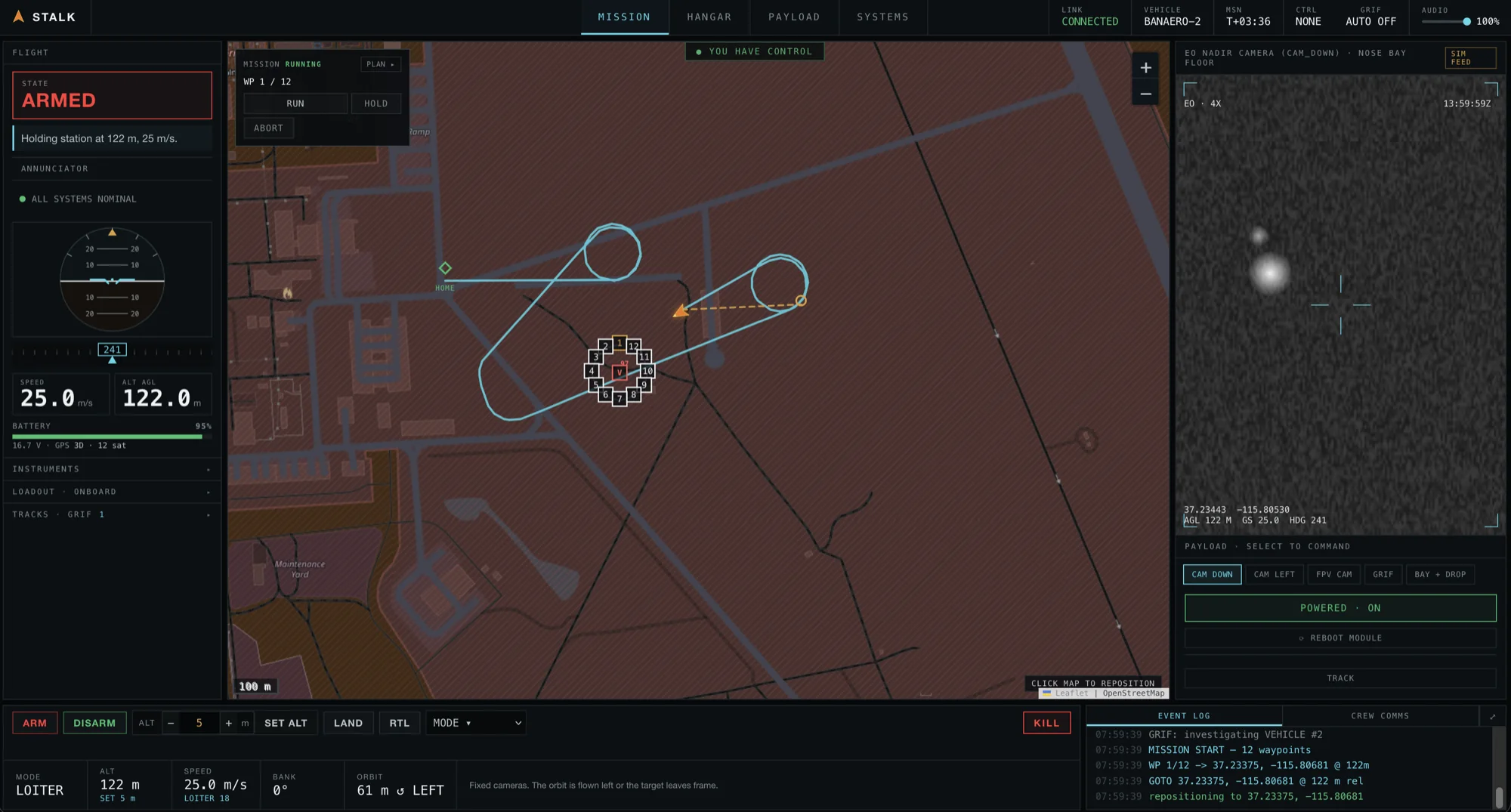
Detection and geolocation
A neural detector runs on the nadir and side camera feeds and puts every detection on the Stalk map as a geolocated track: class, confidence, and a position on the ground. The projection uses the live roll and pitch, because the cameras are fixed rather than gimballed.
Trained in house
The model is ours, trained and refined in house on our own imagery, and it is taught what a mission needs: smoke and fire for a wildfire district, people and vehicles for a search, a specific object for an inspection. One training loop, applied to many jobs.
The roster
Distinct individuals matched by appearance, so the same person crossing the frame twice is one entry rather than two. That is how the question of who came and went gets answered.
Hound
Give it a photo or a description and it watches every frame for a match, then calls it out the moment it sees one. Search and rescue in a single feature.
Search and confirm
Task Grif to look for people or vehicles and choose what happens on contact: investigate or alert. In investigate, the aircraft leaves the search lanes, flies an orbit-and-stare on the contact, and resumes the pattern where it left off. In AUTO it does that without asking.
When the link drops
Grif does not go blind and land. It holds the mission onboard and hands control back when the link returns. Most drones stop being useful the moment the video stream does.
Every action Grif takes runs through the same geofenced, abortable mission path a human command does. Kill, the geofence, the link-loss failsafe, and the single-commander lock all sit above it. Human on the loop is the design rather than a caveat.
Appearance re-identification, not facial recognition. Grif does not know names or faces. It does not fly the aircraft either. The open flight controller does that, and Grif decides what to do next.
One operator gives the intent and Stalk plans the flight.
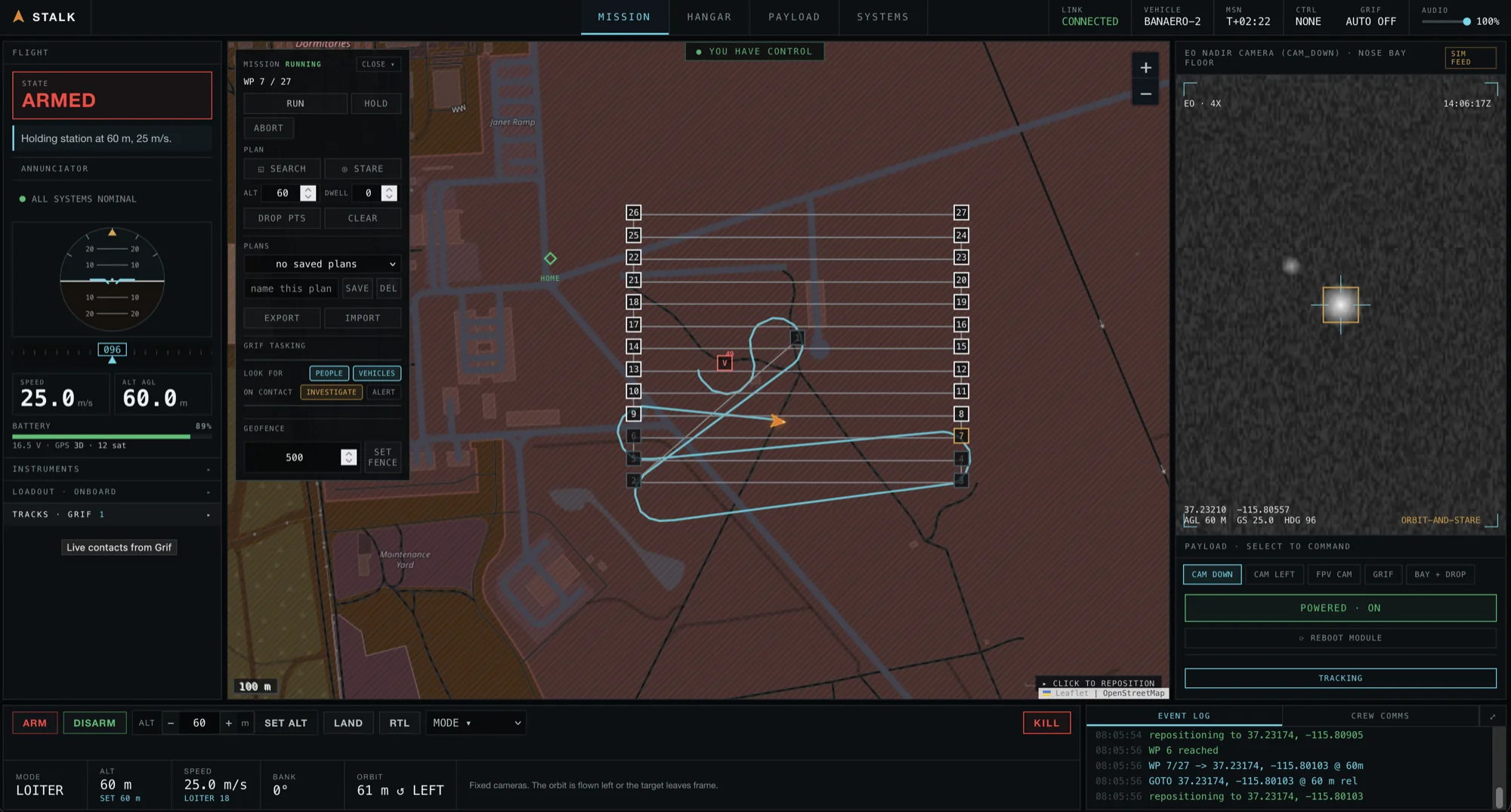
Stalk is the cockpit: a web application that runs on a laptop or a rugged tablet and connects to the aircraft over MAVLink. Four tabs, Mission, Hangar, Payload, and Systems, and one command bar. Draw a search area or drop a stare point, and Stalk lays out the pattern, checks it, and shows you the plan before you press run.
Flies the aircraft
Arm, launch, land, return to launch, set altitude, click the map to reposition. Every command is checked against what the aircraft actually reports, and refused with a reason when it is unsafe.
Plans from intent
Lane spacing comes from the camera footprint, the orbit radius and bank from the fixed camera's geometry, and the altitude floor and the geofence are checked before the plan is offered. Plans save, export, and import.
Tasks Grif
Look for people, vehicles, or both. On contact, investigate or alert. Live contacts from Grif land on the map and in the event log, and a tap on one puts the camera on it.
Runs the payload
Nadir camera, side camera, FPV, the Grif module, and the bay, each selectable and commandable from the payload panel. Power, reboot, and tracking are one press each.
Keeps the crew honest
You have control is a banner, not an assumption. One commander at a time with an announced handoff, a master caution annunciator, a plain-language status line, and crew comms beside the event log.
Fails safe, out loud
A lost link commands a defined action and says so: return, land, or keep going under Grif. Kill is two presses and always live for anyone at the console.
Two sides of one link, built to keep working when the link fails.
One person, one tablet, stating what they need to see and where.
Plans the flight from that intent, checks every command, and shows the brief.
Sees, remembers, and decides onboard, and sends tracks, the roster, and proposals back down.
Stalk is the human's side and Grif is the aircraft's side. When the link drops, Grif holds the mission and Stalk shows the operator that it has. Both stand on open flight software and open protocols. Everything above that line is ours.
An airframe built to be everywhere and cheap enough to replace without flinching.
A tailless low-observable flying wing with a wingspan of six and a half feet and up, built in house. Launch by hand or bungee from wherever you are standing. Loiter for hours, the way a flying wing should. Land in a field, a lot, or a clearing, and go again. Lose one and you are out a few thousand dollars, not a few million.
Tailless flying wing · Six and a half feet of span and up · Built in house · Three pieces, one case · Hand or bungee launch · Lands anywhere · Modular payload bay
Designed for NDAA compliance with US and allied parts throughout, on the path to Blue UAS.
One system for civil and defense missions on the same day.
Every capability earns its keep in both worlds. The payload and the software decide the job, and one cheap airframe flown in numbers serves many.
Wildfire and disaster
Catch an ignition in the first minutes, not the first hour. Hold eyes on a flood line or a fire edge without a crew in the air.
Search and rescue
Seed it with a photo or a description and fly the search box. It does not get tired, and it alerts on the match.
Site and perimeter security
Not motion detected. Who and what was there, when they arrived, when they left, and whether they came back.
Infrastructure and land
Fly the line, the fence, or the field. Image what needs a closer look and land where the truck is parked.
Communications
Hold or extend a signal over an area where the towers are down or the spectrum is contested.
Mapping and sensing
Imaging and sensor passes over a site. Thermal, multispectral, RF, or environmental, by changing the module rather than the aircraft.
In production now, in the air this October.
Banaero-2 is being built in our shop today. First flight is set for October 2026, with validation flights following in coordination with state and county agencies who want eyes over their ground.
In production
Banaero-2 airframes being built in the Nana Works shop. Grif and Stalk flying the full mission set against the open flight stack.
First flight
Manual override and kill path proven before power. Then the first sortie, filmed.
Validation flights
Search, loiter, and relay sorties with state and county partners. Real terrain, real weather, real footage for Grif's models.
Compliance file
Country-of-origin record for every part, then Green UAS submission toward the Blue UAS list.
Wink on the outside, rigor on the inside.
The name is a joke and the execution is not. We got tired of watching prestigious-sounding shops over-promise, under-deliver, and cash the check, so we built one with a ridiculous name and a standard they cannot touch.
A small team writing the whole stack above a proven open flight core, aimed exactly where the field is moving: affordable, attritable, autonomous aircraft in one operator's hands, at a size and price the incumbents do not serve.
Built and flown by people who have done this before.
We are a flight team. Between us we have started other stealth companies, worked inside classified programs, and built and tested air and space systems. This one carries a banana on the patch and the same standard.

The banana in the flight suit has a service record.
Nana flew the SR-71 on sorties that are still classified. He trained at Pax River and has kept a low profile at Dreamland ever since. He is serious about the mission and hard charging the way Frank Borman's generation of test pilots was: fly the profile, write it down, fly it again.
He stands for one idea. Working hard means taking risks, and a risk can look silly at first glance. So can a banana in a flight suit.
The shop where it gets made.
Nana Works is the Banana Aerospace machine shop. Airframes are built there, the autonomy tray is assembled on the same bench, and every change flies in the simulator before anything is cut. A small team with full ownership, moving fast.
Stickers, shirts, and a way to back the work.
Low cost on purpose. Every order helps keep an aircraft on the bench and a flight on the calendar. The store opens in October 2026, and if you leave your email you hear first.
Nana die-cut sticker
Flight yellow, weatherproof, sized for a laptop lid or a hard case.
Banana Aerospace tee
Heavyweight, near-black, a small wordmark on the chest. Quiet on the outside.
Nana patch
Nana himself, embroidered and hook-and-loop backed, for the flight suit you already own.
Talk to us.
Mission owners, program offices, primes, investors, and people who want to build this with us. Tell us what you need to see and where.